Finding solutions to some of the most important global challenges we face in food security, human health and climate change is at the core of much of the research that is conducted across our park campus.
One of our main aims is to maximise the impact of this publicly-funded research by translating ground-breaking discoveries into real world impacts. One way to help us achieve this is through the formation of companies that will have the capability to bring the benefits to market. Anglia Innovation Partnership, the campus management organisation for Norwich Research Park, has been successful in running an incubation programme, as part of its enterprise strategy, that supports the development of start-up, spin-out and spin-in companies based across the campus to do exactly that.
The four research institutes, university and university hospital, based at Norwich Research Park, each have a Technology and Commercialisation Office to support spin-out business ideas. They look at the potential each one has and put in place procedures that will protect the intellectual property (IP) of that particular idea. The organisations usually establish a commercial relationship with each spin-out through a licensing deal and/or shareholding to earn a share of its future value that can then be reinvested back into research and additional commercialisations.
At the point of ‘spinning out’, Anglia Innovation Partnership steps in to support the ‘early-stage entrepreneurs’ who have set up these companies. It provides them with the information and help they need to prove that their idea is deliverable, marketable and valuable, developing a sustainable business model.
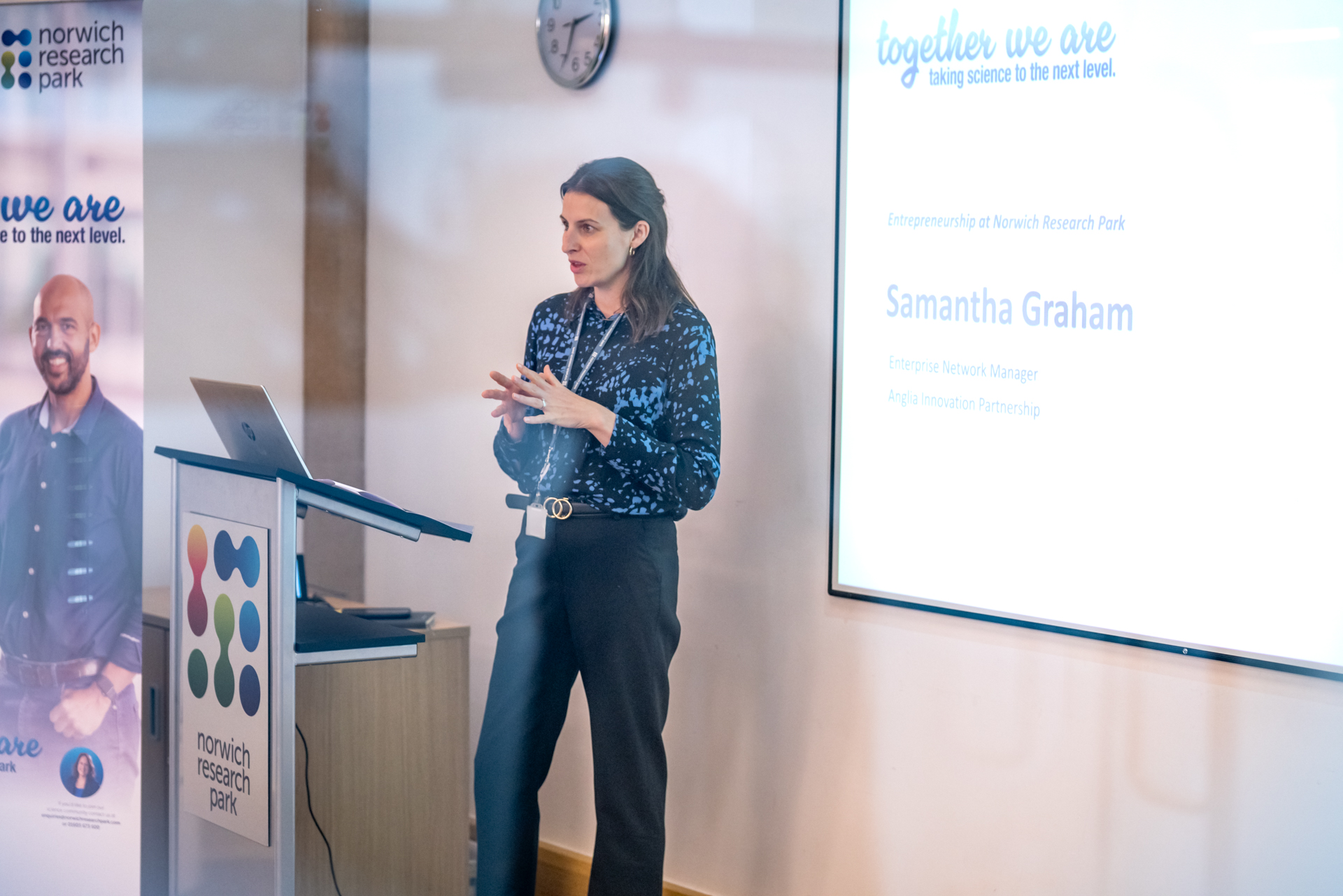
Sam Graham, Anglia Innovation Partnership’s Enterprise Network Manager, said, “We support ‘early-stage entrepreneurs’ to explore the validity of their ideas in the marketplace. Our pre-seed fund offers up to £30,000, per year. This can help them to validate and further develop their ideas, to reach a key milestone on their commercialisation journey and to attract further funding. Companies have gone on to secure larger grants and early stage investment for sums of between £500,000 and £1m.
“We can also introduce them to organisations that can provide seed funding that is often needed to run field trials, secure patents and recruit staff.”
TraitSeq is a successful spin-out from the Earlham Institute that secured pre-seed funding from Anglia Innovation Partnership’s fund. Its co-founder and COO, Felicity Knowles, said, “The pre-seed funding was really valuable for the development of our business idea. It meant we could act quickly to get our ideas off the ground and to deliver a proof of concept to potential investors. The access to funding and the ability to collaborate with others across the campus meant we were able to advance our technology a lot quicker than if we were based somewhere else.”
Whilst spin-outs, spin-ins and start-ups require different types of support, Anglia Innovation Partnership’s incubation programme supports and caters for each of them.
To help the community of early stage entrepreneurs to maximise their potential, the incubation programme provides support in three core areas:
- Skills and knowledge gaps – many of the individuals that spin out a company are scientists or researchers that have to become CEOs overnight which can be a challenging transition –one-to-one support is available to meet each individual’s needs.
- Connections – a seminar programme provides introductions, guidance and sound business advice on issues such as IP patents, finance, tax and marketing.
- Access to a supportive community – founding a company on your own can be isolating so being part of a wider community can help. Being able to talk to others on a similar journey can help develop the confidence needed to face new challenges and refine personal strategies to succeed.
Sam said, “I see my role, primarily, as supporting founders in forming their companies so that they can achieve sustained business growth. We run a number of masterclasses, delivered by experts, to fill the skills and knowledge gaps, provide introductions and connections with professional services experts that they will need to work with and hold a number of community events so that they can meet other people in the same situation to share experiences and to have a sense of belonging.”
As well as providing pre-seed funding, the incubation programme can introduce companies to specialist IP lawyers to help with patents and other organisations who can help them access grants. Some companies will require seed funding to get the company ‘investment ready’. Sam connects them with local organisations such as Anglia Capital Group as well as investors that support early-stage businesses.
Small spin-out companies need to move rapidly to generate revenue. Being flexible is often the key to achieving this. Providing their underlying technology is sound, companies can often pivot their core idea to apply it in a new and more rapidly progressing area. It is usually possible to return later to the original market vision, on which the company was founded, and early investors will often see such a decision as a good demonstration of the founders’ business acumen, especially when pitching for further funding and grants.
A great example of this type of decision-making was made by Cellexcel, a spin-out company from the University of East Anglia (UEA), which benefited from Anglia Innovation Partnership’s pre-seed funding in its early stages. It was launched to develop water-resistant biocomposite materials for use in a variety of sectors, including the aerospace and automotive industries. Establishing a foothold in these two markets can take many years so, to create a more immediate revenue stream, the team adapted its technology to work in the paper industry which has resulted in a quicker return for their early investors. Following that success, Cellexcel has also conducted a seed funding round that will provide them with the platform to take its technology into commercial applications that will generate repeatable revenue streams.
Norwich Research Park is currently home to around 50 small and medium-sized companies. The campus is on an ambitious growth trajectory to more than double in size over the next few years. The incubation programme will be central to delivering that ambition and, with new laboratory and office accommodation planned, there will be plenty of room for companies to grow. The high-growth environment is also attractive to multinationals who want to create partnerships with the research community and start-ups working in their industry sectors.