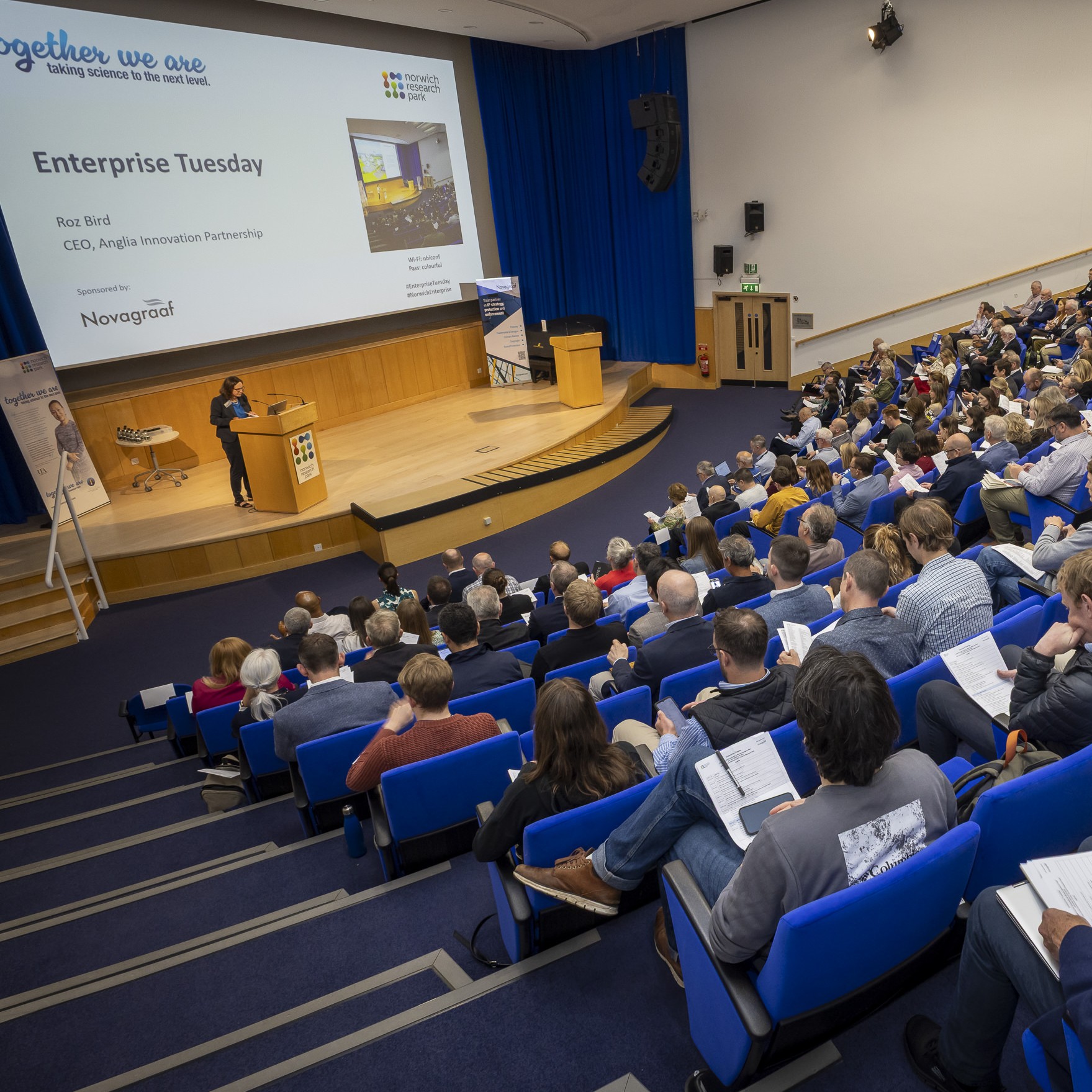
Welcome to the latest edition of our HotHouse Competition Spotlight series! In this special feature, we introduce the remarkable finalists of the Innovation HotHouse competition, taking centre stage at Norwich Research Park’s Enterprise Tuesday event on 25th November.
Eight fledgling businesses have made it to the final, where they will deliver a five-minute pitch to the judges to try and persuade them that their idea is the most attractive proposition for investors.
Throughout this series, we’ll highlight their future ambitions, challenges faced by transitioning from research to entrepreneurship, and what being a finalist in the competition means to them.
Quadlytics
Bacteriophages, commonly called phages, are helpful viruses that can be used as alternatives to antibiotics to kill bacteria in humans, animals and in the environment. Quadlytics’ patent-pending technology identifies combinations of phages that work better together to produce efficient phage-based antimicrobials for numerous applications. This technology has the potential to transform the use of phages in human and animal health, and in agriculture, and contribute to the effort in eradicating antimicrobial resistant bacteria.
Hannah Morelli, a co-founder of Quadlytics who works at the Quadram Institute said, “As an academic, one of the biggest challenges I have faced is navigating the steep learning curve of transitioning from research to entrepreneurship. Having to quickly get up to speed on subject areas very different from my scientific background, such as understanding directors’ duties, regulatory frameworks, venture capital investment and company management is all very new to me but exciting to learn about!
“Having said that, I’ve thoroughly enjoyed the HotHouse competition process that has helped me to expand my skill set, attend workshops and gain the practical knowledge needed to establish and grow a biotech company. The 1:1 support with Michael (and Samantha) has been invaluable especially on things like receiving direct feedback on how to improve my pitch deck. It’s something I’m sure not many people starting a company would have the opportunity to do. The discussions with Michael have been really thought provoking and have helped me narrow down certain aspects of my business and really define my ultimate objective.”
Vertebral Fragility Fractures
Vertebral Fragility Fractures is re-auditing the identification of vertebral fragility fractures, via radiology imaging to identify which patients require a review of their bone health evaluation and osteoporosis treatment. This will create real impact for better service delivery for patients, creating stronger links with primary care and cost benefits to the NHS. It effectively provides a warning flag for osteoporosis
Kate Lucas, who works at NNUH, is driving forward the idea. She said, “As my business idea is in the very early stages, there are, of course, many challenges to face and overcome. I am working at the moment on the concept and linking with primary care groups to develop a working prototype.”
She went on to say that she really enjoyed the ‘How to Pitch’ workshop and found the one-to-one mentoring sessions with Michael Grange and Sam Graham very informative and helpful.
Zyvex® Antimicrobial
Zyvex® Antimicrobial has developed an antimicrobial formulation that is a breakthrough in food safety. Created entirely from Food Standards Agency (FSA)-approved materials, it is 100% organic, completely food-safe and edible, yet it significantly reduces the presence of all FSA-listed food-borne bacteria including Listeria. Based at Norwich Research Park, Zyvex® Antimicrobial’s formulation is safe, environmentally friendly and carbon negative.
One of its co-founders Yan Fen Lee, said, “Our biggest challenge to date has been securing investment to scale our product development and bring it to market. It’s also been demanding to demonstrate food safety and regulatory compliance of our formulation for use in the food industry.”
When asked about which part of the HotHouse competition process, she has most benefited from, she said, “Learning about other innovative businesses at Norwich Research Park has been both insightful and inspiring. The diversity of ideas and technologies is impressive. The 5-minute pitch training and other workshops have been especially valuable, helping us to refine our message for future presentations and investor meetings.”
Agseer
Agseer is developing image datasets and AI computer vision models that can be used by autonomous robots to understand mixed-species agricultural environments. Its approach involves populating digitally simulated fields with 3D models of real plants which avoids model biases common to synthetic image generation. It also allows Agseer to develop training datasets that have diversity far exceeding that of real fields.
Agseer’s founder is Joshua Williams who works at the John Innes Centre. He said, “My biggest challenge has been bridging my scientific background with a business mindset, which requires an entirely new way of thinking and communicating. In science, the focus is on proving technical findings to peers, whereas in business, technical correctness is assumed so the emphasis is on demonstrating customer value. My personal learning has been to move beyond the technical details that excite me and focus instead on clearly articulating the value our product delivers.
“To that end, the one-to-one mentorship with Michael Grange has been the most beneficial and enjoyable part of the process. HIs advice on refining the message in my pitch helped me to strip away unnecessary details to focus on the points that most clearly communicate the value of Agseer’s app. I consider this approach to be instrumental in our recent success in securing a UEA Student Enterprise grant.”
WeAreHistoryHub
WeAreHistoryHub is a bold, new, innovative education platform that aims to transform how history is taught in UK schools. Founded by historian and curriculum consultant Rosa Legeno-Bell, it offers inclusive support to teachers with ready-to-use, academically-rigorous schemes of learning that align with national standards while actively decolonising the curriculum.
Rosa, a teacher who studied at UEA, explains the challenges she has faced, “For five years I juggled building a business with teaching full-time, often working evenings and weekends to keep the vision alive. Now, I have taken the leap and stepped away from teaching so I can fully commit to WeAreHistoryHub. It is exciting but also scary, because I have a family to support and no guaranteed salary behind me. I have the passion, ideas and experience to make this work, but not a large pool of money to invest or to pay myself while it gets off the ground.
“Moving from teacher to entrepreneur has been a crash course in itself and creating a curriculum of this depth and rigour is a huge undertaking. Every unit has to be watertight, inclusive and inspiring. Convincing sceptics has also been a challenge, especially when similar initiatives have failed in the past, but our design is built for classrooms, not just campaigns. Balancing ambition with financial reality has been one of the hardest parts, but it has pushed me to be creative, resourceful and relentless.”
When it comes to the most beneficial aspects of the HotHouse competition process, she said, “The most valuable part has been the coaching on storytelling, taking raw passion and shaping it into a pitch that resonates with educators, investors and partners. The mentors have pushed me to think bigger and sharper. Being surrounded by other innovators has been electric, it feels like we are all secretly building the future together. Above all, the process has made me ‘own’ the ambition, not just what we do but why it has to matter at scale.”
BeanTastic Hummus
BeanTastic Hummus offers clean label, tasty and nutritious hummus made in Norfolk. The company is developing ‘MenoTastic Hummus’, a functional hummus dip formulated with evidence-backed ingredients to support women’s health and potentially reduce menopause symptoms.
Rudy Maor, co-founder of BeanTastic Hummus, a Norwich Research Park based business, said, “The biggest challenge I face in setting up your business is the time management needed between this and my other commitments as an agri-tech consultant and the Royal Society Entrepreneur in Residence at the John Innes Centre.
“The mentoring sessions with Michael Grange have been very useful. It’s exciting to see the pitch and the company’s strategy behind it evolve.”
RhosynBio
RhosynBio is pioneering a novel antimicrobial surface modification designed to prevent biofilm formation. Bacterial biofilms are resilient communities that adhere to surfaces and create serious problems including infection, contamination, corrosion and equipment fouling across sectors such as healthcare, water systems and the food industry. Unlike conventional methods that rely on cleaning agents or antibiotics, RhosynBio offers a passive, long-lasting and environmentally friendly defence against harmful microbes.
RhosynBio has emerged from a collaboration between the UEA, the Quadram Institute and the Norfolk and Norwich University Hospital (NNUH).
Founder, Dannielle Cox-Pridmore, said, “Biofilms affect many industries, so a key challenge has been identifying the market segments where our technology can have the greatest impact. I’m passionate about reducing food spoilage and improving safety so I can see a real opportunity to make a difference in food production and processing environments. Finding the right customers and understanding their needs has been a real learning, but it’s essential to ensure our technology delivers real-world value.
Commenting on the HotHouse competition process that has benefited her the most, Danielle said, “The pitch training and preparation support have been very useful. It has pushed me to refine the narrative, not just focusing on the scientific novelty, but also highlighting the commercial impact and the value for customers.”
Frthst
‘Crit’ is a functional assistive AI tool from Frthst that’s designed to remove language barriers for individuals with dyslexia. It uses a camera-first approach, allowing users to instantly capture text from any source that is then processed by an AI engine that simplifies complex sentences, rephrases metaphors and converts text into one of five reading levels.
Founder of Frthst, Frank Walker from the University of East Anglia (UEA), explains one of the challenges he has faced, “The real challenge is defining a credible, targeted and achievable first step, which for us is a focused plan for schools in Norfolk.
As a solo founder, the biggest challenge is balancing the combination of time, resources and expertise. You have to take on many roles – CTO, product manager, logo designer and business strategist – so you have to learn to ruthlessly prioritise what truly matters. That’s why finding the right name and brand identity is still a ‘work in progress’!”
Frank has found the mentorship from Michael Grange to be extremely valuable as it has added an additional layer of accountability. Frank said, “Michael’s help in perfecting my pitch deck has forced me to chip away at ideas, phrases and elements that once seemed important, in order to reveal a clearer representation of our solution, target audience, strategy and true value proposition”.
Stay tuned for our next edition, where we’ll dive deeper into the journeys of our finalists and reveal exclusive insights from ‘behind the scenes’. Don’t miss the chance to discover which innovative ideas are shaping the future.
Missed our first Spotlight Series? Find out more from our finalists about why they entered the competition, and future ambitions, using this article link: Hothouse competition finalists unveiled – Norwich Research Park
Ticket sales will be closing soon, so be sure to secure your place at Enterprise Tuesday by registering here. Don’t miss the chance to witness our finalists’ live pitches, connect with inspiring entrepreneurs, and be part of the excitement as we celebrate innovation in our community.